

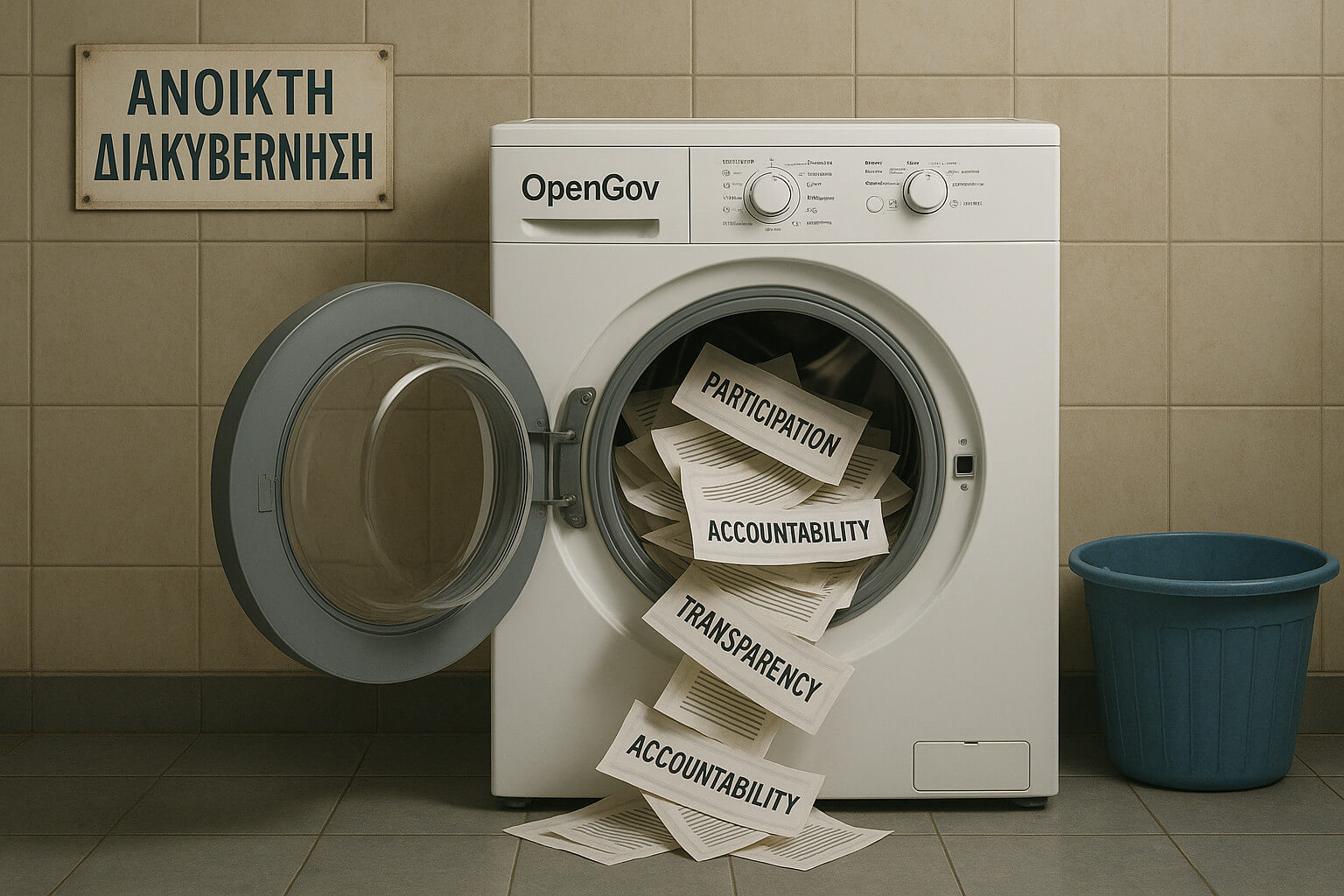
How is it that in some countries, while open governance initiatives are promoted, there is simultaneously a restriction of the "public space" and civil society rights, such as freedom of speech, access to information, or even the ability to protest? This contradiction undermines the essence of open governance and is the subject of a phenomenon that we need to observe closely: a phenomenon we can call "opengov washing."
The proposed term "opengov washing" has not yet been used as an independent term in international literature or practice. However, it is directly related to the broader term "openwashing," which describes the practice of organizations presenting their practices as "open" while, in reality, they do not meet the essential principles of openness, such as transparency and accountability. Open washing was first recognized as a marketing phenomenon by Michelle Thorne in 20091. Audrey Watters further developed this idea in a presentation at OpenCon 20142, defining the phenomenon as "appearing to be open source and open license for marketing purposes while continuing proprietary practices."
The risk of open washing has been observed in many open environments—open software or open code, open data, open licenses, open governance, etc. However, open washing can sometimes be difficult to recognize because the concept of "open" does not have exactly the same meaning in each of these environments. For example, "open hardware" refers to physical objects (such as machines, devices, or other electronic products) whose designs are made available to the public in a way that allows anyone to understand, build, modify, and distribute them. On the other hand, open licenses allow for the free use, modification, and distribution of software. In the context of open data, "open" means that the data is freely accessible, in machine-readable format, reusable, and can be freely distributed by anyone, for any purpose, without restrictions. In this light, open governance represents a governance culture that promotes the principles of transparency, integrity, accountability, and participation, aiming to support democracy3. Therefore, if we wanted to specify openness practices at the level of open governance, that is, focusing on public organizations and considering a form of superficial openness aimed more at improving their public image rather than actually enhancing democratic participation, the term "opengov washing," for the reasons that will be explained below, seems ideal.
Methods of open washing in open governance
Maximilian Heimstädt, in an excellent study in 2017 titled "Openwashing: A decoupling perspective on organizational transparency"4, examines the phenomenon of "open washing," that is, the practice in which public or private sector organizations present an image of transparency and openness while, in reality, concealing critical information or limiting meaningful participation. The study focuses on open data initiatives in cities like New York, London, and Berlin, highlighting the ways these organizations use strategies of "transparency decoupling" to manage their image without implementing real changes.
Although "decoupling" may not be a particularly descriptive or representative term in Greek, it is used in Heimstädt's study to aptly describe the trends of open washing, analyzing the specific methods used:
- Selecting: Organizations select specific data to publish, leaving out information that could raise doubts or reveal shortcomings.
- Bending: Organizations distort or present data in a way that enhances a desired image without reflecting the full reality.
- Orchestrating: Organizations create (orchestrate) a narrative around transparency, showcasing initiatives or achievements that enhance their image while, in practice, limiting actual access or participation.
What could the impact of these methods be in the field of open governance? Below are some illustrative examples from Greece, organized according to the methods just described, to better understand the application of the term opengov washing in the various aspects of open governance.
Selecting
As mentioned earlier, in selective publishing, certain bodies publish only selected datasets, omitting critical information. For example, according to SEV (Greek Federation of Industries)5, Greece has opened only 1% of high-value data, compared to 48% in OECD countries, with the quality of metadata and machine-readable format still in its early stages. The same conclusion is reached by the EU's Open Data Maturity Report for 20246, placing Greece at the bottom of the list of countries complying with the European framework for high-value datasets, alongside Croatia and Bulgaria.
The most important criterion for characterizing a dataset as "open" is not only the appropriate public license but also the availability of the dataset in machine-readable format to facilitate further analysis, processing, or reuse. Three of the most important platforms hosting vast amounts of data are the Central Electronic Register of Public Contracts (KIMDIS), which publishes all public contract announcements over €2,500, the General Commercial Registry (GEMH), which provides public access to company founding documents, balance sheets, general assembly decisions, and articles of association (among others), and the National Printing House, which publishes the Government Laws (FEK). Although the data hosted on these platforms is publicly accessible, none of them provides the necessary infrastructure (i.e., a public API—Application Programming Interface) to make the data available as "open"7, significantly limiting their potential for any purpose (academic, commercial, research, etc.).
Bending
A characteristic example of presenting data in a way that enhances an idealized image without reflecting the full reality is the asset declarations of political figures. Although a platform has been created for submitting these declarations, they are not publicly available through this platform. Therefore, the public availability of this data depends on the body to which the political figures belong. At the level of Local Government, this means it is up to the municipalities and regions to publish the asset declarations of elected officials, with all the inconsistencies and lack of uniformity this entails. At the level of MPs, the Greek Parliament publishes asset declarations8, but the data is neither updated nor in formats that allow easy analysis or processing (they are posted as PDFs). This gap was quickly filled by the Integrity Watch Observatory of Transparency International Greece, an interactive open data platform that presents the revenues, investment products, deposits, and properties declared by MPs in their 2022 asset declarations (for 2021 use)9. It is perhaps worth mentioning that the will of civil society to fill these gaps in transparency or accountability “from below” tends to emerge as a familiar pattern, since the institutional bodies themselves, whether of the central government or of local government, often do not seem to intend to take this essential step on their own. VouliWatch, OpenCouncil and the writer’s own initiative, the Ombudsman of the Citizen and Enterprise Observatory, are also indicative.
However, despite the existence of legislation on Asset Declarations or open data in general, its implementation is incomplete, with the result that the published data is not always up-to-date or complete. That is, while the institutional framework exists, it is practically not implemented or implemented piecemeal, just enough to "tick off" the fulfillment of a commitment to an institutional body such as the EU, without however fulfilling it in a substantial or even useful way. Although emphasis was placed on the typical example of asset declarations, there are -unfortunately- many examples. Another thing that could be mentioned is the gifts that members of the Government and Deputy Ministers have received in the previous year, as well as the names of the donors, which, according to Law 4829/2021, must be posted on the website of the Presidency of the Government. It took two -unanswered- requests for information and an appeal to the National Transparency Authority by Vouliwatch for a rudimentary list of gifts to be published three years after the passage of the specific law - and with several shortcomings10. In fact, the same process (request for documents and another appeal to the National Transparency Authority) had to be repeated to publish the relevant list for 2024, which has not been published to date.
Orchestration
The orchestration of the narrative around open governance refers to the creation of a communication framework that promotes transparency and participation initiatives without substantial implementation. This phenomenon is evident, among many other cases, in Greece's participation in the Open Government Partnership (OGP). Greece has been a member of the OGP since 2011 and has drafted five National Action Plans (NAPs). The fifth NAP (2023–2025) includes 19 commitments in areas such as lobbying regulation, whistleblower protection, and open data for land management. However, the co-creation process of the NAP faced (once again!) difficulties, with limited time preventing meaningful participation from civil society organizations11.
The repeated transfer of commitments from previous action plans without substantial progress, as in the case of the protection of whistleblowers, has also not helped Greece's position in the OGP, reinforcing the impression that the commitments function more as communication tools than as real reforms. Finally, it is indicatively mentioned that in the case of the protection of whistleblowers, the relevant law 4990/2022 was passed, a fact that is not so much due to Greece's willingness to fulfill a commitment in its NAP, as to its obligation to incorporate into its national law the corresponding Directive (EU) 2019/1937 on the protection of persons reporting violations of Union law. Even so, the way in which the Directive was incorporated into national law was largely judged to be from timid to hypocritical, considering that the relevant bill only covers violations of European Law and does not extend its objective scope to cover violations of national law, despite the explicit recommendation and encouragement of the Directive towards this direction. This fact was clearly raised by citizens and civil society organizations (such as Transparency International Greece) already from the stage of the public consultation of the bill12, nevertheless it seems that these objections were not ultimately taken into account.
The consequence of these practices, in addition to acting as a fairly successful example of “orchestration” in the context of opengov washing where image prevails over substance, is that Greece is currently “Under Review” status by OGP due to non-compliance with the minimum requirements for three consecutive cycles of action plans. If the country did not comply with the requirements by the deadline of December 31, 2024, it could be classified as an “inactive” member of OGP13 – something that is now considered quite likely. Of course, Greece is not the only example of how a country can use OGP as a “smoke screen”. Fraundorfer, in a related study in 2017, found that even countries that pioneered OGP, such as the United Kingdom, the United States and Brazil, used it to some extent as a communication tool to distract attention from ongoing problems of corruption and lack of transparency within their own countries14.
The perfect example (to avoid)
Is there a Greek example of “laundering” that combines all three of the aforementioned opengov washing methods? There is, and it is considered one of the greatest “achievements” of open government in modern Greece. It is the Open Government platform OpenGov.gr, which mainly hosts public electronic consultations on draft laws. A new, particularly interesting study by Konstantinos Saravakos and Panagiotis Karkatsoulis on behalf of the Center for Liberal Studies (KEFIM) on “public consultation in Greece in the decade 2014-2024”15 provides some highly illuminating information on the way public consultation is treated in Greece.
Initially, although the obligation for public consultation on proposed laws established by Law 4048/2012 and maintained with the new provisions of Law 4622/2019 concerns all laws under passage, however this has not yet been achieved. Although the percentage of laws that are put to public consultation gradually increases over time, in the period 2023-2024 1/3 of the articles of the laws passed were not included in public consultation. To this selective publication of articles for consultation is added the distortion caused in the process by the duration of the consultations. Specifically, according to the same study, although the statutory time limit for consultations is two weeks (an interval already short compared to the European average), in the period 2023-2024 “1 in 5 laws was available for public consultation for one week or less”. If this fact is combined with the volume of legislative material available in a consultation, where the “average law in the period 2014-2024 was 66 pages long and contained 60 articles”, a pattern of distortion emerges in which the temporal and institutional management of the consultation undermines its effectiveness. Thus, a false image of accountability and participation is created, while in practice participation is limited. In fact, it is worth mentioning that this time limitation does not affect each participant in the same way, taking into account that an organization with sufficient resources can respond more effectively than an ordinary citizen to a time-limited consultation, thereby exerting a greater influence on the final decisions.
As for the orchestration of the transparency narrative, in this case it is relatively self-evident, since despite the substantial weaknesses of the consultation process, opengov.gr remains perhaps the most advertised evidence in the open government communication narrative. The very existence of the platform is part of a broader narrative of participation and transparency, while in practice no substantive dialogue is ensured. In other words, the consultation functions more as a tool for government’s promotion than as a tool for co-shaping laws or policies.
Recognizing Opengov Washing
Having specialized the phenomenon of open washing in open government by using a more representative term such as opengov washing, and having analyzed its main aspects with examples, it is also appropriate to gather certain criteria for a clearer recognition of the phenomenon. Moreover, the recognition of opengov washing phenomena is crucial for enhancing transparency and the meaningful participation of citizens in public affairs. Thus, below are some indications that can help identify such practices:
First, the pretentious participation of citizens is one of the most obvious signs. When consultation processes are limited in time, do not provide sufficient information, do not facilitate participation or do not substantially incorporate the views of participants, then participation functions more as a communication tool than as a means of democratic decision-making. The lack of feedback to citizens on how their suggestions were used reinforces this impression.
Second, the use of technological tools without substantial change may indicate “window dressing”. The creation of digital platforms or applications that are presented as open government innovations, but are not accompanied by changes in decision-making processes or transparency, undermines the essence of open government. When such platforms are not regularly updated, are not user-friendly or do not provide opportunities for meaningful participation, they function more as “fireworks” than as tools for strengthening citizen participation.
Third, selective publication of data is another indication. When only non-critical or already known data is published, while important information relevant to decision-making or resource management remains unavailable, an illusion of transparency is created without meaningful accountability. Finally, the absence of evaluation and feedback on open government initiatives may indicate a lack of commitment. When there are no mechanisms to monitor progress or evaluate results, these initiatives risk remaining at the level of rhetoric.
Instead of an epilogue – What is (and what is not) Open Government
Open government requires more than the simple display of tools or processes. It is not a technological project but a continuous process of "opening up" governance, as a social contract in which national or local authorities commit to transparency, accountability and participation. Finding ways to make public administration more transparent, to develop accountability tools and to strengthen citizen participation in public affairs is not a technocratic exercise. The tools already exist, and especially today, with the rapid development of Artificial Intelligence, they are becoming even faster, "smarter" and more effective. In most cases, there is not even a need to create an appropriate institutional framework in this direction, since it usually already exists to a satisfactory extent. Some examples of this have already been mentioned, such as the legislation on public consultations (the implementation of which shows discrepancies in terms of the duration of consultations) and the legislation on gifts to political figures (which is only implemented after great pressure from civil society).
What is really needed is, on the one hand, the political will for substantial open government measures that will be supported and strengthened over time, and, on the other hand, the cultivation of the relevant open government culture among public administration executives, for the effective implementation of its principles. It requires a profound cultural change that incorporates transparency, accountability and participation as core values in the operation of public bodies. Active citizen participation, continuous feedback and a commitment to improvement are essential elements to avoid “opengov washing” phenomena and achieve true democratic governance. The term opengov washing, in turn, may be a key component of the open washing phenomenon, in order to make more visible the hypocritical use of open government principles by national or local governments. In this way, on the one hand, it sensitizes the democratic sensibilities of citizens, and on the other hand, it offers a series of criteria by which citizens can distinguish and evaluate the substantial intention of the authorities to operate with more transparency, accountability and participation.
Sources
1 Michelle Thorne, Openwashing, March 14, 2009 [https://michellethorne.cc/2009/03/openwashing/]
2 Audrey Watters, From "Open" to Justice, #OpenCon2014, November 16, 2014 [https://hackeducation.com/2014/11/16/from-open-to-justice]
3 OECD (2023), Open Government for Stronger Democracies: A Global Assessment, OECD Publishing, Paris [https://doi.org/10.1787/5478db5b-en]
4 Maximilian Heimstädt, Openwashing: A decoupling perspective on organizational transparency, Technological Forecasting and Social Change, Volume 125, December 2017, Pages 77-86 [https://doi.org/10.1016/j.techfore.2017.03.037]
5 SEV, The value of open public data, Special Reports, 13 December 2024 [https://www.sev.org.gr/ekdoseis/i-axia-ton-anoikton-dimosion-dedomenon/]
6 Open data in Europe 2024 [https://data.europa.eu/en/publications/open-data-maturity/2024]
7 Eliza Triantafyllou, The slow death of open data in Greece, 13.03.2023, iMEdD Lab [https://lab.imedd.org/en/the-slow-death-of-open-data-in-greece/]
8 Asset Declarations, Hellenic Parliament [https://www.hellenicparliament.gr/Organosi-kai-Leitourgia/epitropi-elegxou-ton-oikonomikon-ton-komaton-kai-ton-vouleftwn/dilosi-periousiakis-katastasis-arxiki]
9 International Transparency Greece, Integrity Watch [https://www.integritywatch.gr/]
10 MPs' Gifts, VouliWatch [https://vouliwatch.gr/tag/dora-ypoyrgon]
11 Greece Action Plan Review 2022-2024, 3rd November 2023 [https://www.opengovpartnership.org/documents/greece-action-plan-review-2022-2024/]
12 Completion of the public electronic consultation on the legislative initiative of the Ministry of Justice entitled: "Protection of persons reporting breaches of Union law - Transposition of Directive (EU) 2019/1937 of the European Parliament and of the Council of 23 October 2019 (L05)». [https://www.opengov.gr/ministryofjustice/?p=16219]
13 Resolution of the OGP Steering Committee Regarding the Participation Status of Greece in the Open Government Partnership, 15 April 2024 [https://www.opengovpartnership.org/wp-content/uploads/2024/05/Greece_Under-Review-Resolution_20240415.pdf]
14 Markus Fraundorfer (2017), The Open Government Partnership: Mere smokescreen or new paradigm?, Globalizations, 14(4), 611-620. [https://doi.org/10.1080/14747731.2016.1236463]
15 Konstantinos Saravakos and Panagiotis Karkatsoulis, Public consultation in Greece in the decade 2014-2024, Policy Brief No. #10, September 2024, KEFIM [https://kefim.org/nea-meleti-tou-kefim-gia-ti-dimosia-diavoulefsi/]