

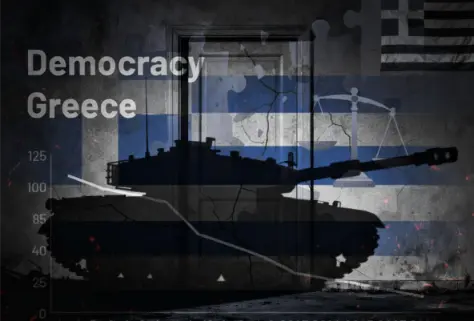
Democracy does not always die through coups, tanks, or civil wars. Sometimes, it dies silently, behind closed doors, through small but systematic concessions.
Today, Greece, while not yet leaving the category of democracies, is experiencing democratic backsliding that deeply affects the structure and quality of democratic governance. This is part of a wave of “autocratization”—a gradual transformation toward a non-democratic regime—that is not imposed openly but develops incrementally and covertly, through legal and institutional interventions that weaken fundamental democratic pillars.
The retreat is measurable and already documented.
Modern scholarly literature defines the retreat of democracy as democratic backsliding or, more broadly, autocratization, which affects three main arenas:
- Elections: Freedom, fairness, and competition are restricted through legal and practical obstacles.
- Checks and balances: Power concentrates in the executive branch, while oversight institutions (courts, independent agencies) shrink.
- Governance capacity: The effective functioning of democratically elected institutions and citizens’ shared perception of reality are undermined, complicating informed political decision-making.
Greece exemplifies these phenomena, with documented institutional interventions and social polarization. Greece is at a stage where “autocratization” is pursued through legal and organizational practices that avoid labeling the regime as authoritarian but, in practice, lead to the loss of democratic freedoms and functions. According to Dahl (1971), Bermeo (2016), and Levitsky & Ziblatt (2018), such progressive alterations cause “democratic erosion,” challenging the essence of democracy and endangering the fundamental democratic character of the political system.
The democratic retreat in Greece, though covert and multifaceted, is clearly evidenced by various international indices and theoretical approaches, showing a concerning, steady decline:
- Significant drop in political rights and civil liberties indicators, with a 0.57 decrease in the Economist Intelligence Unit (EIU) Democracy Index.
- Decline in V-Dem indices across critical pillars, such as justice, press freedom, and limits on executive power.
- Gradual retreat of Freedom House in political freedom and rights.
- The GSOD index shows a clear downward trend in areas like judicial independence, freedom of expression, governance with limited transparency, and shrinking citizen participation beyond elections [GSOD Report, 2023].
- Polity IV, which maintains a high overall score, does not sufficiently capture the qualitative aspects of the crisis.
V-Dem classifies Greece as an autocratizer, i.e., a country in transition toward an authoritarian regime, with significant institutional retreat and serious deterioration in freedom of expression, press freedom, and political rights. Nevertheless, electoral integrity is considered generally strong. The overall trend is a decline in democratic quality to levels reminiscent of the 1980s, characterized as “democratic backsliding.” Overall, Greece is categorized as an “electoral democracy,” meeting minimal electoral criteria but exhibiting serious institutional weaknesses and setbacks in other dimensions.
GSOD indices present a milder but still troubling picture: Greece is positioned as a country with medium-to-declining democratic quality, showing some reductions in rights and the rule of law, ongoing vulnerability, and governance challenges. Key issues remain access to justice, political representation, and corruption, although electoral systems and representativeness are still considered strong.
This concerning picture is corroborated by the European Commission and the European Parliament, which document risks to democracy, the rule of law, and fundamental rights in Greece. Similarly, unfavorable Eurostat data and OECD findings show limited effectiveness of public administration, very low citizen trust in institutions, delays in justice, and problems with legislative quality, confirming the institutional crisis.
At institutional and social levels, the following are observed:
- Government interventions in the judiciary, undermining its independence and eroding trust in the rule of law.
- Expansion of emergency legislation, restricting parliamentary debate, disrupting the normal legislative process, and reducing democratic accountability.
- Chronic poor legislation, creating legal uncertainty and fostering opacity and corruption.
- Restrictions on press freedom through political control, interventions, censorship practices, and financial pressure, limiting oversight of power.
- Increasing political polarization, with extreme voices and clientelist practices undermining democracy.
- Attacks on and delegitimization of institutional checks and balances, such as independent authorities.
- Inability (or deliberate neglect) to implement comprehensive reforms addressing state dysfunctions.
- Systematic violation or misinterpretation of the Constitution to fit political purposes.
- Instrumentalization of the public sector, targeting civil servants through populist measures, turning them into scapegoats instead of pillars of the state, and ensuring dependence on political power.
- Electoral transparency limited by clientelist networks, opaque financing, and restrictions on opposition, undermining a sense of justice and representation.
- Police violence and arbitrariness with simultaneous lack of accountability.
- Scandals, corruption, erosion of rights, absence of consultation and accountability—a continually expanding list.
The Need for Democratic Vigilance
The retreat of democracy in Greece is a subtle, slow, and dangerous process, threatening the core of freedom and political existence. Democracy is not explicitly abolished but gradually eroded, a process where authoritarianism and absolutism wear a legal mask and take a covert form—they are not imposed abruptly, provoke no strong reactions, cause no shock, and mobilize no opposition.
This “covert autocratization” is particularly dangerous because it strips democracy of its tools without provoking mass responses. Gradual weakening of judicial independence, control over information, shrinking freedoms, and rising political polarization leave little room for immediate reaction, trapping citizens in a cycle of delegitimization and silence.
It is a (not so) invisible threat. Over time, speaking about it becomes simultaneously more urgent and more difficult. If we do not awaken from this lethargy now, it will soon not be easy to reclaim the democratic path we once took for granted.
Reversing this negative trend requires a return to fundamental democratic values, strengthening institutions, transparency, and active social participation with knowledge, courage, and determination. The theory of democratic resilience emphasizes that democratic institutions, citizens, and social organizations can withstand pressures and challenges, maintaining and strengthening democratic functions and creating a protective framework against erosion and retreat. Responsibility lies with all of us. Indifference is the greatest and most dangerous obstacle in this story. Allow this silent retreat to continue, and we risk awakening in a society not just resembling authoritarianism—but being one.
P.S. Do not look for ideologies behind the retreat of democracy. Unlike the “gray” leaders of the past, today’s representatives of Autocracy, Inc. (according to A. Applebaum) prefer luxury real estate to party offices. Greece seems to be adapting to this model, where power is exercised not through ideas but through interests.
Institutions are weakened precisely to serve this network: leaders function more as CEOs than politicians, maintaining ties based on deals, technology exchanges (e.g., surveillance software), and mutual cover. In modern political theory, this is described as the transition from ideological totalitarianism to “transactional authoritarianism” and organizing governance like a profit-driven enterprise, where institutional erosion is not a side effect but a prerequisite for “regime survival” and impunity for its members. Democracy’s retreat, therefore, is a precondition for sustaining this cycle of wealth and power.