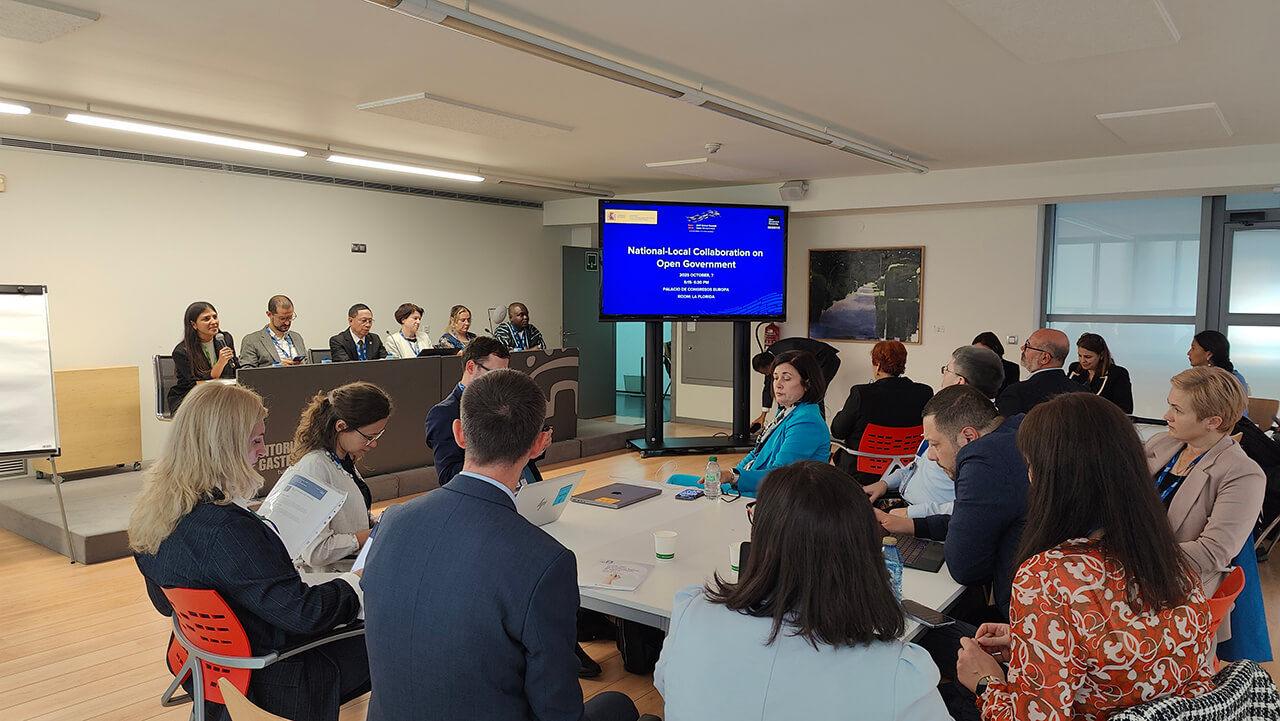


Ioannis Fytros, Municipality of Athens's Point of Contact to OGP Local and member of IERP, conveys from Vitoria-Gasteiz the spirit of the Open Government Partnership (OGP) Global Summit 2025. The message was clear: less slogans, more implementation. Trust in institutions is built through action, transparency, and accountability.
The global open government community met in Vitoria-Gasteiz, the capital of the Basque Country, on 6–10 October 2025, and sent a persistent message: less slogans, more implementation. The scale of the event - over 2,000 participants from dozens of countries - did not conceal the contradictions of the era; it brought them to light. If there is one thing I took away from attending a Global OGP Summit for the first time, in my capacity as the Contact Point of the Municipality of Athens - the first and only Greek municipality participating in OGP Local - it is that those keeping the “transparency–participation–accountability” triad alive demand mechanisms that work in practice, across all levels of governance, measurable and under public scrutiny.
The Vitoria-Gasteiz Declaration, published ahead of the Summit with strong symbolic weight, clearly captured this collective demand. It does not describe a “good intentions agenda” but a shared horizon of action, ensuring that the principles of open government permeate all sectors and levels of power - from parliament to city hall - with an emphasis on protecting democratic space and strengthening institutional resilience. It is no surprise that Greece was absent from the list of OGP signatory member states (as it was also from the Summit itself). For the other members - whether national governments, local authorities, or civil society organizations (such as GFOSS and Vouliwatch, the only Greek signatories) - the call is explicit: those who sign must demonstrate leadership and results. At a time when polarization and crises erode trust in democratic institutions, the Declaration serves as a shared compass. The real test, of course, is implementation.

As with any global summit, there was no shortage of generalities and lofty rhetoric. Yet in many sessions - especially in side events and breakout sessions -conversations tended to go deeper, seeking answers beyond slogans. If I were to summarize “what the OGP community is asking for today,” I would start from the local level. The OGP Local initiative - which now includes about 150 local authorities (among them the Municipality of Athens) and, as clearly stated, cannot take on new members in the immediate future - is not treated as an “annex” to OGP, but as a thriving arena where the most tangible reforms take shape: participatory institutions that go beyond online platforms, open data that fuels real-time public accountability, and horizontal coordination that breaks administrative silos. Where these exist, one sees cultural shifts; where they don’t, one sees institutional fatigue and civic cynicism. This realization echoed through many sessions and even more hallway conversations in venues such as the Europa Biltzar Jauregia convention center, the Basque Parliament, and other landmark sites across Vitoria-Gasteiz that hosted the Global Summit.
The second clear demand concerned digital rights and digital governance. The community is not simply calling for “more innovation” but for institutional safeguards ensuring that innovation serves the public interest: algorithmic and data transparency, portability, open standards, public digital infrastructure, and accountability for impact. In these discussions, “digital sovereignty” was presented not as an ideological slogan but as a practical necessity - rules, oversight, and communities that govern the digital commons so that data and AI work for people. Special credit goes to Renata Ávila and the team of the Open Knowledge Foundation, who spoke frankly in every panel and session, calling things by their name. For instance, when discussing data sovereignty, they left no room for ambiguity: what emerged as a concern 10–15 years ago has now turned into a full-blown nightmare, as a handful of multinational giants “host” massive amounts of public data on their cloud infrastructures - with all the risks that entails.

The third demand was tied to public procurement of artificial intelligence. Here, discussions became more animated: how can we design participatory processes from the definition of a need to the evaluation of implementation? How do we ensure that criteria are open, assessment data accessible, and that citizens - especially those most directly affected - have a voice before irreversible decisions are made? The guides and playbooks presented on participatory AI procurement offered concrete steps: creating multi-stakeholder oversight groups, requiring publicly released test results, and holding pre-market dialogues with transparent documentation. These are not luxuries - they are prerequisites for trustworthy, transparent, and accountable AI adoption in the public sector.
Behind these “what” questions lies a deeper “why”: the crisis of trust. Citizens are not convinced by new apps if they cannot see timely and verifiable results. Hence, the repeated call for policy cycles with binding timelines, open data for progress, and accountability not only for what was done but also for what was not. As repeatedly emphasized, openness is not a management tool but a foundation of trust - especially in times of multiple crises.
All this, however, highlights one final and often overlooked question: how is open government experienced by those who serve it from within? In one of the most participatory sessions, a reflection emerged from the perspective of public servants themselves: that public administration often becomes a “ping-pong ball” between short-lived, flashy public policies and citizens who, disillusioned by institutional inconsistency, gradually lose trust in government. Public employees, for their part, often find themselves at the center of this distrust - bearing collective blame or becoming scapegoats whenever a corruption scandal breaks or a policy fails. It is no coincidence that even in Greece, the recent public debate has reached the point of discussing the abolition of civil service tenure - a symptom of a deeper trust crisis that shows that without stronger institutional integrity and professional protection, open government has little chance to truly take root.